One more update about the aroma cards campaign on indiegogo
I received one more idea on how to use the aroma card + 5 additional very famous yo-ji-juku-go idiomatic phrases:
Here you are!
★Idea of usage: use your aroma card as a bookmark! it is longlasting, pleasant to touch and fragrant. Can you find a better reading companion?
★5 additional yojijukugo to choose from:
以心伝心(read: i-shin-den-shin)
translation: that thinks transmit heart
meaning: “Without any need for words”
一期一会 (read: ichi-go-ichi-e)
translation: one period one meeting
meaning: “once-in-a-lifetime opportunity”
海千山千 (read:umi-sen-yama-sen)
translation: sea 1000(years) mountain 1000(years)
meaning: “sly old dog of much worldly wisdom”
電光石火 (read: den-kō-sek-ka)
translation: electricity light stone fire
meaning: “as fast as lightning”
一日一歩 (read:ichi-nichi-ip-po)
translation: one day one step
meaning: “one step each day”
How about these ones?
I added them at the survey about the aroma cards campaign.
First of all, with 5 days of delay after the beginning of the campaign I finally managed to put together the video!
During the interviews many people mentioned the yo-ji-juku-go (four character idionatic expressions).
I think this actually matches perfectly the concept of the product.
I was considering using some haiku poems (for the “extreme” japan-lovers) and some motivational quotes (for the more pragmatic ones) but the idea of using the yo-ji-juku-go puts the two concepts together!
Idiomatic expressions are like proverbs but have the peculiarity of consisting on 4 ideograms.
No verbs, no conjunctive particles or hiragana characters.
Just 4 concepts or qualities that also create a peculiar sound combination.
Some are more straight forward like:
一石二鳥
(read: i-sseki-ni-cho)
translation: one stone two birds
meaning: “Killing two birds with one stone”
others definitely require an explanation like:
温故知新
(read: on-ko-chi-shin)
translation: warm circumstance know new
meaning: “Learning from the past”
At first the meaning may not be immediate, but once you know the meaning, the idiomatic expressions have a particularly dense meaning and convey the concept powerfully, in full color.
Everybody has their own “favorite yo-ji-juku-go”, like a personal mantra or policy that you can say in your mind to receive that relaxing caress or courage boost you need in your everyday life.
There are many yo-ji-juku-go. I’ve found counts ranging from 5,000 to over 20,000. Wikipedia page about yu-ji-juku-go links to a database of 3,400 of them while Japanese students learn at school some 400-500 fundamental idiomatic expressions.
I will pick up some I like. Feel free to comment if you have more to share!
花鳥風月
(read: ka-cyou-fu-getsu)
translation: flowers birds wind moon
meaning: “The beauties of nature”
十人十色
(read: juu-nin-to-iro)
translation: 10 people 10 colors
meaning: “To each his own”
晴耕雨読
(read: sei-kou-u-doku)
translation: sunny cultivate rain read
meaning: “Living in quiet retirement dividing time between work and intellectual pursuits”
臨機応変
(read: rin-ki-ou-hen)
translation: extraordinary happening listen different
meaning: “Playing it by ear”
We are receiving many orders of kadomaru tubs.
Maybe because of the following amazing salespoints? 1) it is reasonable, 2) compact and lightweight 3) it requires only 1 week from order to shipping 4) allows savings on packaging and transportation
I have to apologize as we are not managing to maintain the promise on 2 of the points above (but are working hard to re-establish the best conditions…!)
Here is the “new kadomaru” features: 1) reasonable: no change 2) compact and lightweight: no change 3) it requires only 1 week from order to shipping: sorry, we require 2-3 weeks but will try to contain the delay as much as possible. 4) allows savings on packaging and transportation: same price but better packaging!
(see also this article)
Remember also that you can order a kadomaru tub directly from the shop (note that there are 2 sizes: S and L).
Contact us by email or thru the contact form if you need any customization/options.
It finally happened.
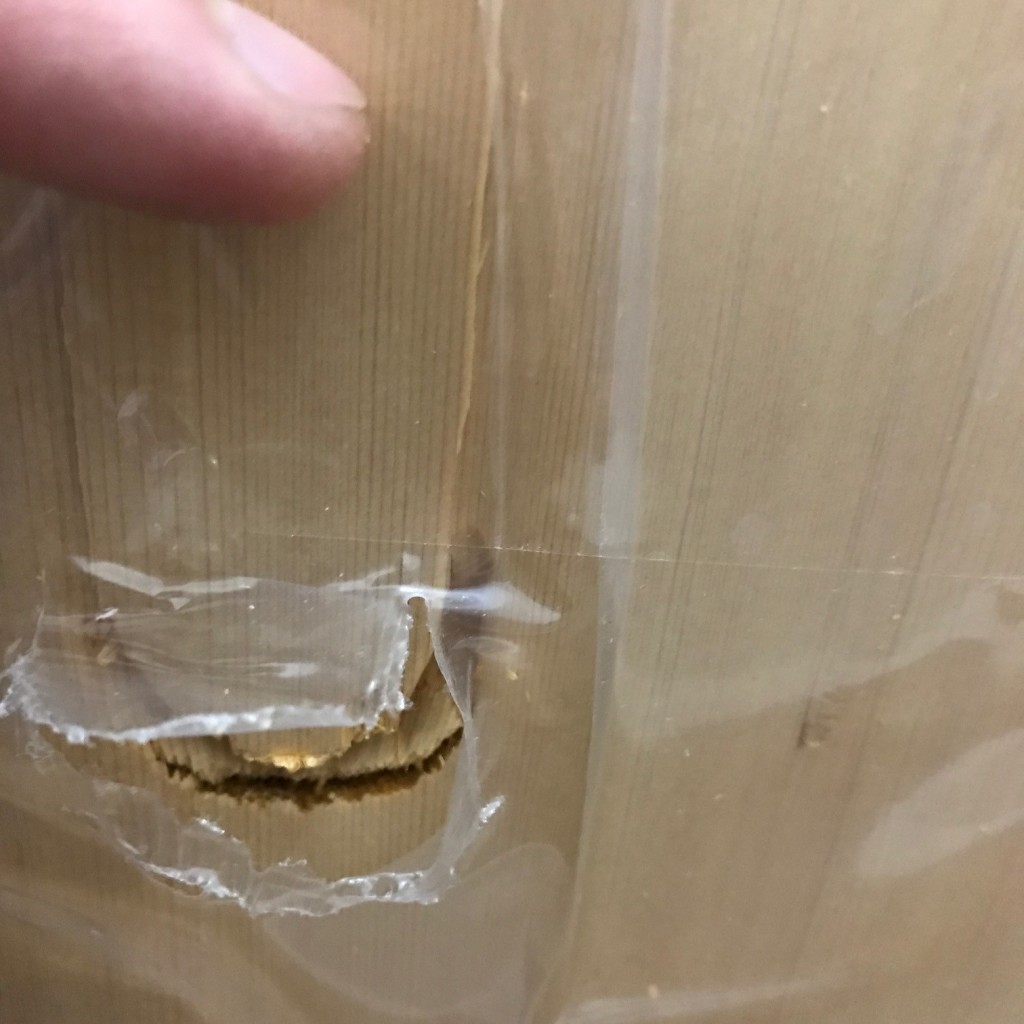
After 14 years of paying the transportation insurance without need to use it we had our first accident.
Of course I am deeply sorry with the client but I confirm that we were able to replace the tub with a pristine one.
Actually we had in the past 2 damage reports about bathroom accessories arriving in smashed cardboard boxes (both in the USA with air mail…) but never experienced a damage to a tub.
Yes, with this first shipping damage experience which brings the accident rate to 1:240 which is about the 0.4%.
The client promptly reported the damage (it must be done within one week) and since it was a kadomaru type we could make a new one in a week time. The tub will be shipped as “replacement item – free of charge” so there are no taxes involved and if any customs inspection is required we will take care of the cost.
But this story has a silver lining, actually 2!
#1 Sturdier box
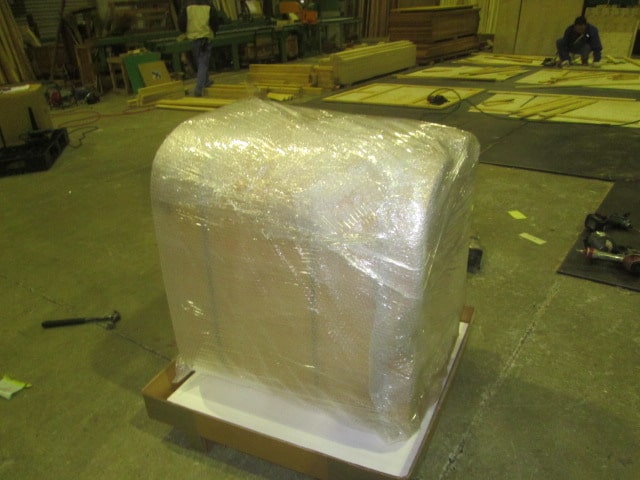
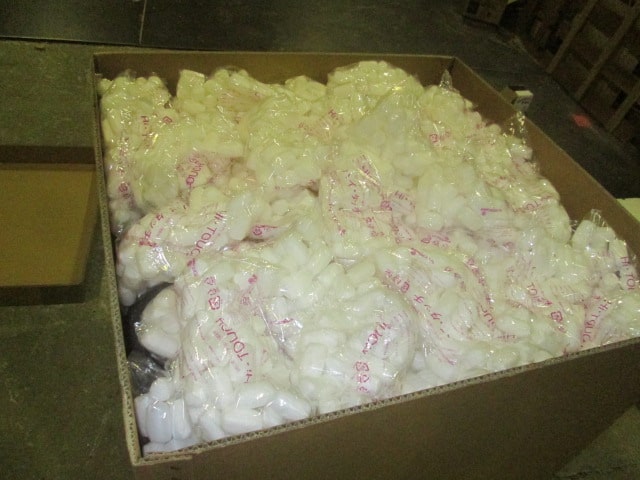
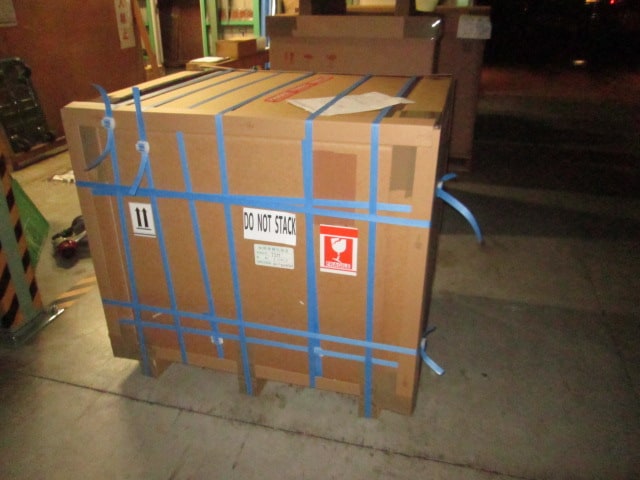
no doubt the box was mistreated. It was dropped probably more than once and was pierced by a steel pipe. Anyway we could learn the weak-points of the box and changed the packaging method. The new box is much sturdier and prevents the tub from moving inside.
#2 Same cost
The packaging we will be using from now on is actually more expensive. But actually we also find a new service from our forwarder which will enable us to lower the shipping cost. They will use flexibly DHL or UPS according to the space available and provide a better fare which compensates the additional cost of the reinforced box. Therefore we will be able to offer a safer transportation for the same price!
NOTE:
Cardboard boxes are used only for Kadomaru tubs. All custom tubs are shipped in a plywood completely closed crate.
Please read the information here below before purchasing a japanese tub.
Also, we recommend to do a {search} within the FAQS for the keywords you are concerned about.
Do not forget to browse the “download area” in the “REFERENCE” section.
It is useful to check the “installation” section in the “DETAILS” menu.
Once you are ready to place your quotation request, go thru the “tub details” section for a thorough step-by step explanation.
You can do your final recap and fill the form in the “how to order” section.
Here are the main reasons: 1) The material is expensive. 2) The craftmanship is expensive. 3) The shipping cost is expensive.
Anyway, we ship directly from the maker to the end user so you can be sure that there is no overhead and you are getting value for every penny spent.
What are the differences between Japanese ofuro and tubs made in the U.S.?
Here are the 3 main differences between US-made tubs and real japanese tubs which make the two products difficult to compare. 1a) almost all US made tubs are coated with urethane. The look is natural but may feel a little cold and hard (like plastic) and have no aroma. 1b) Japanese made tubs are un-coated. You can feel the warmth, aroma and soft touch of wood but if the environment is too humid they may develop mold stains.
2a) US made tubs are assembled as a cabinet (see the corner mitered joint) and often made of finger joint glue-laminated wood. 2b) Japanese tubs are and are built like a boat and are made of solid wide lumber laminated with dowels
3a) US made tubs are made in red cedar, hard woods (like teak) or Port Orford Cedar (most of the makers call it hinoki – but it is not.) Please note that hinoki usable as construction material grows in Japan and Taiwan only. 3b) Japanese tubs are made with japanese softwoods (hinoki, asnaro, sawara, koyamaki). For flooring or wainscoting we use man planted lumber while for making tubs we use exclusively 250-300 year old trees lumber from primary forests.
Well seasoned wood is very stable but in extreme conditions of dryness it may warp or crack.
I am afraid it is not possible.
As most of our clients are private users, it is our policy not to use them as a reference.
Arranging a meeting between an old customer and a perspective client may be time consuming, may be invasive of the privacy and we just have not the structure to be able to take responsibility for any trouble or miscommunication.
As we cannot be on site to manage the situation, we cannot refer past clients and we make no exception to this policy.
Thank you for your understanding.
Yes, we did it again! (this time thanks to the generosity of a client)
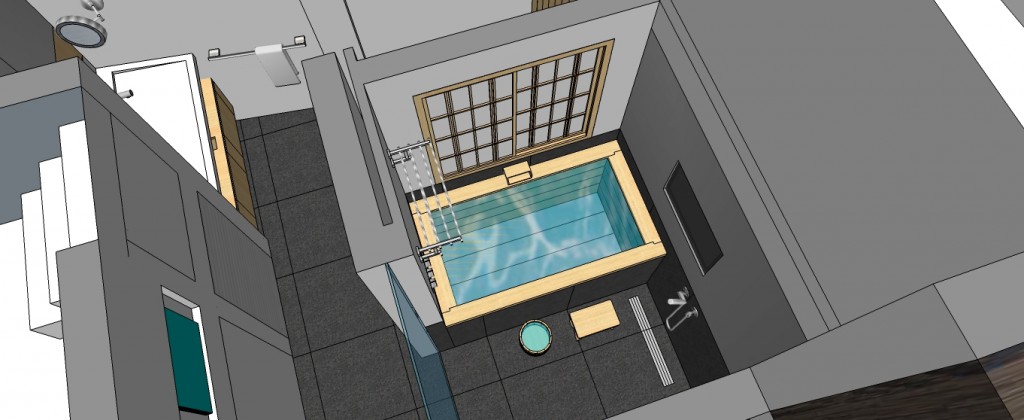
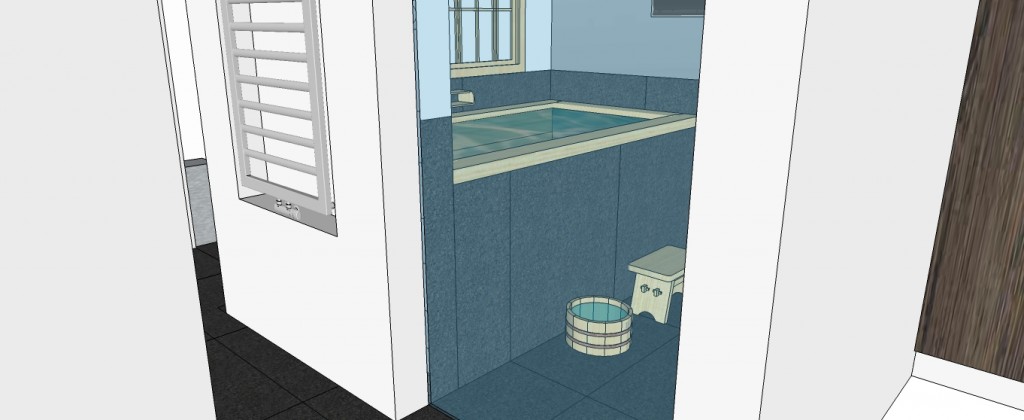
Here is another ofuro you can use in sketch-up.
This solution consists of the tub buried behind a ledge, so you can see only the inside and the beefed up kamachi border.
The sketch up model is not so detailed so if you explode the parts or check it in the hidden areas inside the ditch you will probably not find what you are looking for: anyway it is great for a presentation or just to rotate it in perspective view and get a feeling of the space.
Just some general advice please – the tub is looking tired and I was considering sanding it to bring back some luster to the wood.
I was planning on using an orbital sander and wooden sanding block. I have not oiled the tub and is this something I should be doing at least on the outside?
If so, what oil do you recommend?
I recommend to let the tub dry and sand with medium and fine grit.
Then, we recommend the application of a water-repellent which is colorless, matte finish and will not block the wood aroma.
It is a non-coating treatment and penetrates in the wood fibers letting it breath (like “goretex” for fabric…).
We recommend to finish the Hinoki tub with water repellent
KIHADAICHIBAN (preservative agent for wood) :
a) 7,000. JPY / 1L + 4,500. JPY (Packaging + EMS) + Paypal fee = 12,000 JPY
Please let me know.
Best regards,
iacopo torrini